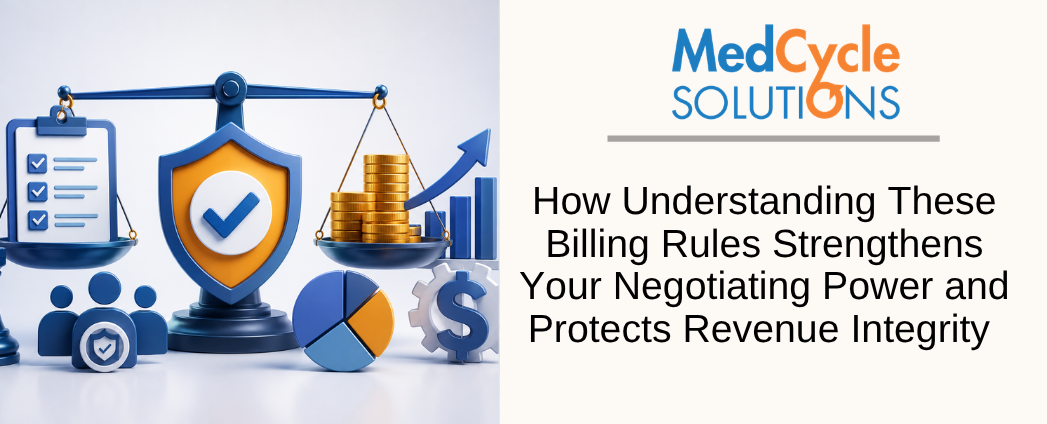
How Understanding These Billing Rules Strengthens Your Negotiating Power and Protects Revenue Integrity
In today’s healthcare environment, successful contract and fee negotiations depend on far more than comparing reimbursement rates. Payers expect practices to understand federal billing rules, remain compliant, and justify their contractual needs using accurate data. Two areas that significantly influence reimbursement outcomes—yet are often overlooked during negotiations—are Incident-To and Split/Shared visits.
At MedCycle Solutions, we help practices leverage their service mix, coding patterns, and compliance programs to negotiate higher, more accurate fee schedules. Understanding how Incident-To and Split/Shared visits impact revenue allows organizations to negotiate from a position of strength.
This blog breaks down why these visit types matter, where payer negotiations intersect with compliance, and how practices can protect financial performance through informed contracting.
Why Incident-To & Split/Shared Visits Matter in Contract Negotiations
Incident-To and Split/Shared visits influence:
- Reimbursement rates
- Provider productivity benchmarks
- Service-level utilization
- Payer mix analysis
- Documentation expectations
- Audit risk
- Network participation requirements
When these services are billed correctly, they represent legitimate, billable work that deserves appropriate payment. During contract negotiations, demonstrating correct usage and compliance allows practices to request:
- Higher fees for key CPT codes
- Expanded coverage for NPP-delivered care
- Recognition for team-based models
- Improved reimbursement for high-acuity E/M visits
- Better contract terms tied to workforce utilization
Without understanding these billing structures, practices may leave money on the table—or enter agreements that do not support their care delivery model.
Incident-To Services: Contract Implications
Incident-To services allow non-physician practitioners (NPPs) to bill under a supervising physician’s NPI at 100% of the Medicare Physician Fee Schedule—but only when all regulatory requirements are met.
Why This Matters in Negotiations
Payers often view Incident-To utilization as an efficiency enhancer that:
- Expands access to care
- Reduces provider burnout
- Supports team-based workflows
- Maintains high-quality service levels
Practices can use this to:
Negotiate Higher Rates for Key E/M Codes
Incident-To often applies to high-volume visits such as:
- 99212–99215 (established patient visits)
- Chronic care follow-up visits
- Condition management encounters
Because NPPs can see more follow-up patients, these visits may represent significant contract value.
Leverage NPP Utilization Data
Showing how NPPs increase access and manage chronic care can justify:
- Higher fee schedule percentages
- Better rates on key chronic care codes
- Expanded authorization exemptions
- More favorable credentialing requirements
Support Value-Based Care Negotiations
Incident-To volume demonstrates:
- Care continuity
- Chronic disease management
- Efficient care delivery
These are strong bargaining points for payers.
Split/Shared Services: Contract Implications
Split/Shared visits apply when both a physician and an NPP provide portions of an E/M service in a facility setting. Medicare and many payers allow these visits to be billed under the provider who performs the “substantive portion,” often leading to higher reimbursement when billed under the physician.
Why This Matters in Negotiations
Split/Shared services often involve:
- Hospital inpatient E/M codes
- Observation services
- Emergency department visits
- Hospital outpatient encounters
These are high-value, high-acuity codes.
Leveraging Split/Shared utilization allows practices to:
Negotiate Higher Rates for Hospital-Based E/M Codes
High-volume codes such as 99232, 99233, or ED visits often represent key reimbursement opportunities.
Improve Payer Recognition of Care Team Structures
Payers must understand the role of NPPs in:
- Hospital rounds
- Admission/discharge management
- Observation care
- ED follow-up
Clear articulation strengthens your negotiation position.
Justify Rate Adjustments for Time-Based Care
Because Split/Shared relies heavily on time, data showing provider time investment helps demonstrate:
- Higher acuity
- Increased workload
- Justification for enhanced reimbursement
Where Compliance Intersects With Contract Negotiations
Payers are more likely to negotiate favorably when a practice demonstrates:
- Strong compliance programs
- Provider training on federal guidelines
- Clear documentation standards
- Audit-readiness
- Consistent adherence to Incident-To and Split/Shared rules
- Low improper billing rates
- Accurate time documentation for Split/Shared visits
Compliance is leverage.
Payers prefer contracting with practices that demonstrate:
- Lower risk
- Lower administrative burden
- Predictable claim patterns
- Strong documentation integrity
MedCycle Solutions helps practices use compliance as a strategic negotiating tool.
How to Use Incident-To & Split/Shared Data to Strengthen Negotiations
- Analyze Utilization Trends
Identify how often NPPs:
- Conduct follow-up visits
- Support chronic care
- Contribute to inpatient rounding
- Participate in shared encounters
This shows payers how your team delivers efficient, coordinated care.
- Highlight Cost-Efficiency
Incident-To and Split/Shared demonstrate:
- Reduced physician strain
- Expanded access
- Efficient staffing models
- Lower per-visit operating costs
Payers respond favorably to cost-efficient, high-quality delivery.
- Present Audit-Proof Documentation Standards
Demonstrating compliance reduces payer risk and increases negotiating flexibility.
- Use Revenue Impact Models
Show payers:
- How rate changes affect billable volumes
- How NPP utilization improves throughput
- The financial impact of expanded coverage
Negotiations strengthen when you bring data, not just requests.
- Address Prior Authorization and Network Barriers
Use your Incident-To and Split/Shared operational model to negotiate fewer administrative burdens.
How MedCycle Solutions Supports Practices During Negotiations
MedCycle Solutions provides strategic support for practices negotiating payer contracts by:
- Analyzing Incident-To and Split/Shared utilization data
- Reviewing E/M trends and provider productivity
- Identifying high-value negotiation targets
- Preparing financial models and payer comparison reports
- Ensuring compliance readiness to reduce payer pushback
- Highlighting care-team efficiencies for negotiation leverage
- Guiding practices through contract language review
We help organizations negotiate from a position of strength—with clean data, compliance integrity, and strategic clarity.
Final Thoughts
Incident-To and Split/Shared services are more than billing rules—they are strategic components of contract and fee negotiations. Practices that understand how these services affect utilization, cost-efficiency, documentation, and reimbursement can negotiate stronger contracts and protect long-term financial performance.
MedCycle Solutions empowers practices with the data, compliance structure, and strategic insights needed to negotiate effectively and maximize contract value.
If your organization needs help preparing for negotiations or understanding how these services influence reimbursement, our team is ready to support you.