
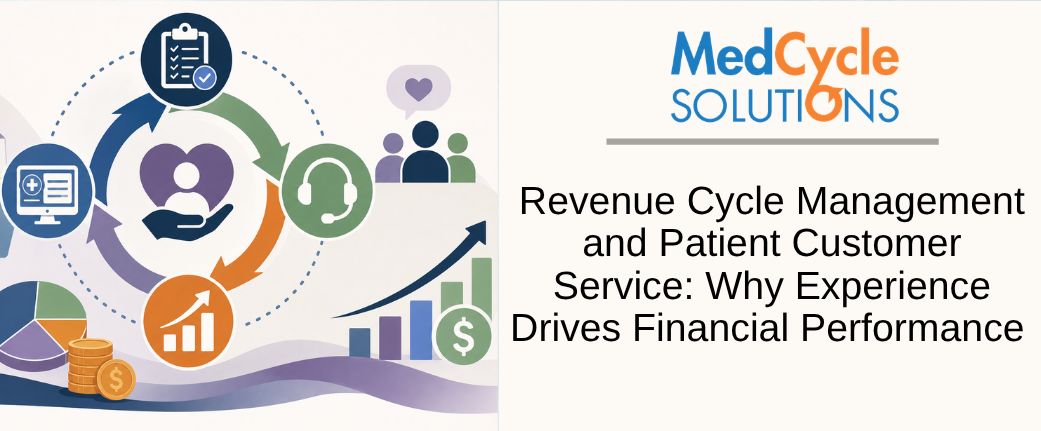
In today’s healthcare environment, revenue cycle management (RCM) and patient customer service are inseparable. Every interaction—whether scheduling an appointment, explaining a balance, or resolving a billing question—directly impacts cash flow, compliance, and patient trust.
At MedCycle Solutions, we consistently see that organizations with strong patient-centered customer service outperform those that focus on billing mechanics alone. The revenue cycle doesn’t begin with a claim—it begins with the patient experience.
Patient Customer Service Is Embedded in the Revenue Cycle
RCM touches the patient at multiple points, including:
- Scheduling and registration
- Insurance verification and financial clearance
- Point-of-service collections
- Billing statements and follow-up
- Payment resolution and account closure
When communication breaks down at any stage, the downstream effects include denials, delayed payments, disputes, and patient dissatisfaction.
The Cost of Poor Customer Service in RCM
Ineffective patient communication often results in:
- Increased call volume and repeat inquiries
- Higher account aging and write-offs
- Escalated complaints and negative reviews
- Compliance risks related to billing transparency
- Erosion of patient trust and loyalty
These outcomes are not just service issues—they are revenue risks.
Key RCM Touchpoints Where Customer Service Matters Most
1. Scheduling and Registration
Clear communication at the front end sets expectations for:
- Insurance coverage and eligibility
- Financial responsibility
- Required documentation
When patients understand what to expect, practices reduce no-shows and downstream billing disputes.
2. Financial Conversations and Transparency
Patient-facing staff must be trained to:
- Explain balances and estimates clearly
- Communicate payment options professionally
- Handle objections with empathy and accuracy
Transparency builds trust and improves collections.
3. Billing and Follow-Up
Billing inquiries are often emotional for patients. Effective customer service ensures:
- Faster issue resolution
- Fewer escalations
- Reduced repeat calls
- Clear pathways for dispute resolution
Empathetic, knowledgeable staff protect both patient relationships and cash flow.
4. Compliance and Regulatory Alignment
Customer service in RCM must align with:
- HIPAA privacy standards
- No Surprises Act requirements
- Accurate financial disclosures
- Proper use of ABNs and patient agreements
Compliance failures often begin with miscommunication, not malicious intent.
Training and Consistency Are Critical
Strong patient customer service does not happen organically. It requires:
- Standardized training across departments
- Consistent messaging and scripting
- Regular updates tied to payer and regulatory changes
- Ongoing monitoring and coaching
Without structure, patient communication becomes inconsistent—and risk increases.
Technology Supports—but Does Not Replace—Human Interaction
Automation and patient portals improve efficiency, but they do not replace the need for:
- Clear explanations
- Human empathy
- Skilled problem-solving
Technology should enhance customer service, not create distance between patients and the revenue cycle.
The Measurable Benefits of Patient-Centered RCM
When customer service is integrated into RCM strategy, organizations experience:
- Faster collections
- Reduced billing disputes
- Improved patient satisfaction scores
- Stronger compliance posture
- Lower staff burnout and turnover
Patient experience becomes a financial advantage, not a cost center.
How MedCycle Solutions Aligns RCM and Patient Customer Service
MedCycle Solutions helps healthcare organizations integrate customer service into their revenue cycle through:
- Front-end and back-end RCM optimization
- Patient communication training and scripting
- Compliance-aligned workflows
- Interim staffing and operational support
- Ongoing auditing and performance monitoring
Our approach ensures that every patient interaction supports clarity, compliance, and cash flow.
Final Thoughts
Revenue cycle success is not achieved solely through clean claims—it is built through clear communication, consistent service, and patient trust. When patient customer service is treated as a core component of RCM, organizations protect both their reputation and their revenue.
Let’s connect to build a revenue cycle strategy that puts patients—and performance—first.